Legal Research Blog


Why so serious?

The folks at Google Scholar dug up some entertaining legal opinions this week, and well, the geeks at Fastcase got such a kick out of these decisions that we just have to pass a few along. You can check out Google’s full post here.

Our favorite is Rimes v. Curb Records (2001), a case in which country music star LeAnn Rimes faced record company Curb Records.  Impressively, Chief Judge Buchmeyer wrote this comedic decision “to be sung to the tune of LeAnn Rimes, ‘How Do I Live’.”  Click here to view/print the full opion.  Here’s the first portion…

“LeAnn Rimes

A very rich and famous star

Wasn’t so rich in times afar

But what a talent she had!

Enter Curb

To sign a contract, they hoped

After her talent they scoped…”

Foodies and New Englanders will enjoy the second decision which features a lengthy history of New England Clam Chowder, and even a recipe from The Boston Cooking School Cook Book. Perhaps the White House chefs used a similar recipe here in D.C. for today’s (Friday) White House Soup of the Day, which was also Clam Chowder. Click here to view/print Webster v. Blue Ship Tea Room (1964).  Here’s a portion that truly illustrates the Supreme Judicial Court of Massachusetts’ love for good chowder…

“The defendant asserts that here was a native New Englander eating fish chowder in a “quaint” Boston dining place where she had been before; that “[f]ish chowder, as it is served and enjoyed by New Englanders, is a hearty dish, originally designed to satisfy the appetites of our seamen and fishermen”; that “[t]his court knows well that we are not talking of some insipid broth as is customarily served to convalescents.” We are asked to rule in such fashion that no chef is forced “to reduce the pieces of fish in the chowder to miniscule size in an effort to ascertain if they contained any pieces of bone.” “In so ruling,” we are told (in the defendant’s brief), “the court will not only uphold its reputation for legal knowledge and acumen, but will, as loyal sons of Massachusetts, save our world-renowned fish chowder from degenerating into an insipid broth containing the mere essence of its former stature as a culinary masterpiece.”

Familiar with any colorful decisions?  Shoot us an email to comments@fastcase.com, we’d love to post it, tweet it, or just have a laugh.

Fastcase for the iPad is Here!

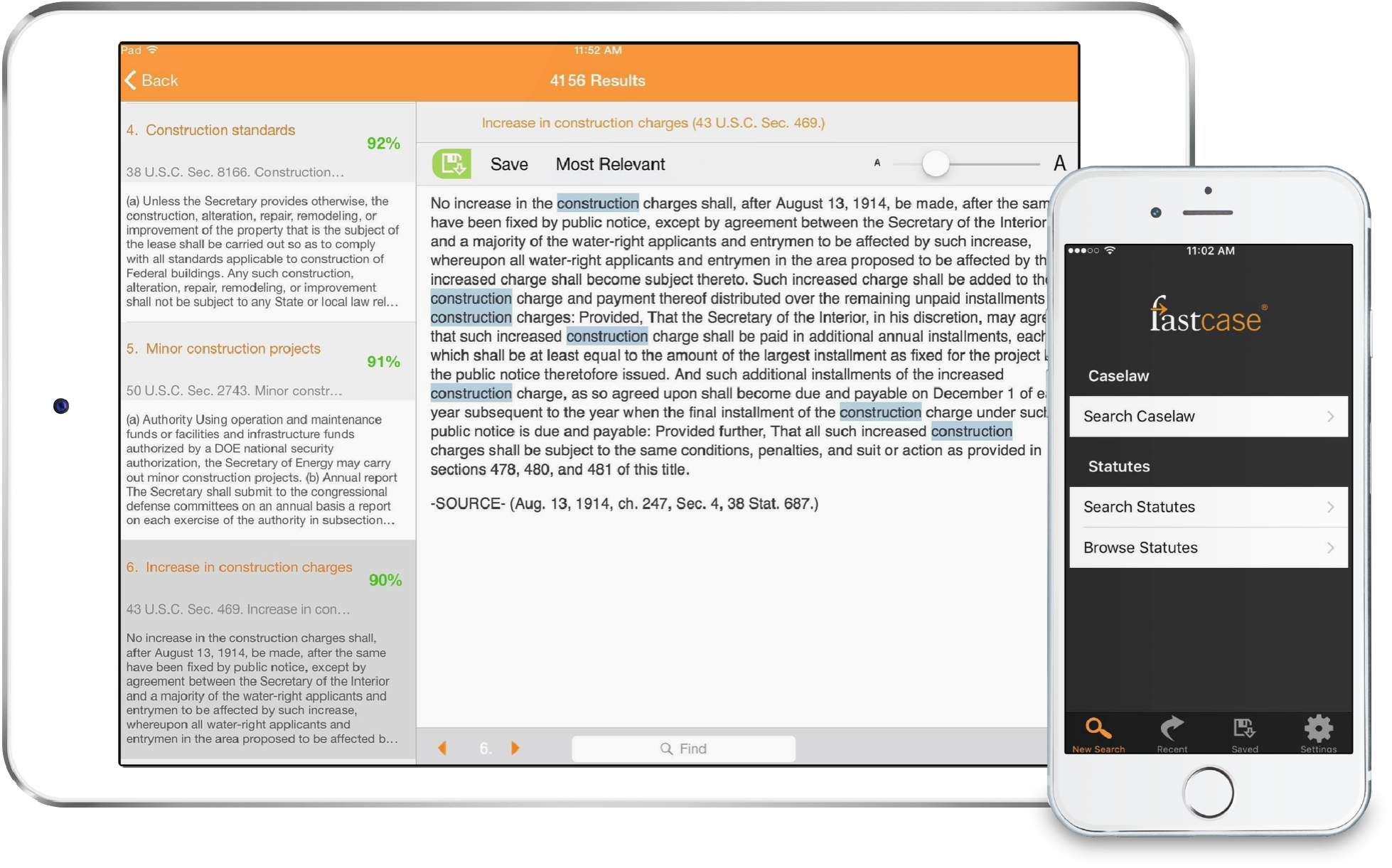
We are delighted to announce Fastcase for the iPad, the most recent addition to our family of mobile apps. The new app (which is compatible with iPhones as well), takes full advantage of the iPad’s gorgeous high definition display, making it even easier to read cases and statutes on go.

Like the original Fastcase app, Fastcase for the iPad is available as a free download in the iTunes store, allowing you to search our comprehensive library of state and federal primary law for free.

Fastcase for the iPad gives you instant access to an entire set of case law reporters and statute books wherever you are, making the iPad the only legal pad you need in your briefcase.

Fastcase iPad App

What’s New:

- Even cleaner and sleeker navigation in high definition.

- Access your complete list of search results when viewing the full text of a document.

- Choose from 5 different font sizes using the font slider.

- Easily search within a document using the “Find” bar.

- Manage (and delete) your save documents using an improved saving feature.

Press and Reviews

Click here for the official press release.
Review by Josh Auriemma of Legal Geekery.
Review by Jeff Richardson of  iPhone JD.
Review by Greg Lambert of 3 Geeks Law Blog
Review by Christi of PadGadget
Review by Bonnie Shucha of WisBlawg

For more information, visit www.fastcase.com/ipad.

Download the app here.

Introducing: Fastcase Forecite

We have had a big couple of weeks here at Fastcase. As you may have heard, our iPhone app was recognized as the New Product of the Year for 2010 by the American Association of Law Libraries (AALL). We are also planning to release a brand new mobile app for the iPad.

If that weren’t already enough, we have a new addition to our suite of smarter legal research tools: Fastcase Forecite®.

What Does Forecite Do?

Forecite, a new addition to our suite of smarter legal research tools, is the perfect backstop to your case law research. When you perform a keyword search on Fastcase, Forecite goes the extra mile and identifies seminal cases that can easily be missed by ordinary keyword searches.

Consider this example.

Let’s say you were researching the Miranda Doctrine under the Fifth Amendment. Can you imagine concluding your research without reading the Supreme Court’s seminal decision, Miranda v. Arizona, 384 U.S. 436 (1966)? We can’t either. The trouble is, if you search for “Miranda doctrine” using most legal research engines, the Miranda decision will not be in your search results, because those words do not appear anywhere in the decision.

This is where Forecite comes in. Run the same search on Fastcase, and Forecite has you covered.

- At the top of your search results screen, you will see a salmon-colored banner indicating that Forecite has identified additional decisions that may be relevant to your research topic, but do not contain your search terms.

- Click the orange View Results button and the first suggested case is Miranda v. Arizona, 384 U.S. 436 (1966).  It is that simple.

Forecite

How Does Forecite Work?

Like Authority Check, Forecite carefully and comprehensively analyzes the citation structure of your search results. Forecite looks for cases that are frequently cited by other cases in your search results that do not contain all of your search terms.

Seeing Is Believing.

But don’t take our word for it, see for yourself.  Sign up for a free, no-strings 24-hr trial of Fastcase to test drive Forecite and the rest of our smarter research tools by visiting www.fastcase.com/subscription.  (Current subscribers to our web-based legal research service already have access to Forecite.  This feature is not currently available on our mobile apps.)

Questions? 1-866-773-2782 or support@fastcase.com.

Happy Independence Day

Fastcase will be closed on Monday July 5, 2010 in observance of Independence Day.
We wish you a wonderful holiday weekend.


cc licensed flickr photo shared by travlinman43

What Eisenhower, UPS, and the Railroads Can Teach Us About Law.gov

Law.gov is a national movement to create better, bulk access to America’s primary law, spearheaded by nonprofit Public.Resource.org and its “rogue archivist” founder Carl Malamud.  Hundreds of participants have met in workshops around the country in the first half of 2010, culminating in June meetings in Washington and Boston.

The June 15 workshop at the Center for American Progress brought together a veritable who’s-who of law and technology:  former White House Chief of Staff John Podesta, Vint Cerf, the father of the Internet and Google’s Chief Internet Evangelist, White House CIO Vivek Kundra, Cornell Legal Information Institute Co-founder Peter Martin, White House Deputy CTO Beth Noveck, Tim Stanley, the CEO of Justia, Mike Walsh, the President and CEO of U.S. Legal Markets/Global Legal Solutions for LexisNexis, publisher and open government luminary Tim O’Reilly — the list literally goes on and on.

Fastcase CEO Ed Walters was a panelist  in the workshop.  In his remarks, Ed addressed a question raised in the first Law.gov meeting at Stanford, “Why should the government try to put Westlaw and Lexis Nexis out of business?”  Because some view open access to the law as a challenge to private publishers, the question had teeth.  In his ten-minute remarks, Ed compared the Law.gov movement to the creation of the first Interstate Highway system in 1956, which (far from competing with private industry) created new markets for incumbents such as railroads, while enabling innovators and entrepreneurs to build and grow new companies.  A video clip of his remarks as delivered, and a very rough transcript are included below.  Enjoy!

Is this Socialism?

At the first Stanford workshop, one of the participants had a troubling question.  They asked whether it was a good idea for the government to try to put Westlaw and LexisNexis out of business.  This was right in the middle of the debate over health care reform, and the undertone of the question was clear: Is Law.gov a big government takeover of legal publishing?  Is this Socialism?

I suggested at Stanford that Law.gov is not a government takeover – that it is an investment in public infrastructure.  It’s building interstate highways, not founding a public railroad.  And as the Law.gov movement has unfolded across the country, the parallels to that movement have become even clearer.

The First Survey of American Roads

The genesis of our Interstate Highways was in World War I, the first war of motor transport, where the efficient movement of machines over roads won battles.  Having learned this lesson in Europe, in 1919 after the way, the Army decided that it was important to be able to move men, machines, and materials quickly across the United States for national defense.  So the Army started the First Transcontinental Motor Convoy, starting a few blocks from here on the Ellipse, driving a massive troop convoy over our roads to San Francisco.  And it was chronicled by a young Lieutenant Colonel named, Dwight Eisenhower.

The trip covered an unprecedented 3,251 miles and took 62 days.  The average speed was just 6 miles per hour.  The convoy lost 9 out of 54 vehicles, and 21 men had to drop out.  The convoy destroyed or damaged 88 highways, bridges, and culverts, and there were 230 separate traffic accidents – mostly trucks sinking in quicksand or mud – because of the varied, and generally poor, condition of state roads.

This was the first real survey of the readiness of our roads, and it reminds me quite a bit of the effort that Erika Wayne has led in her nationwide inventory of legal materials.  I think she has found, as young Dwight Eisenhower did, that it’s easy to overestimate the quality of public goods like roads, or in Erika’s case, public data sets of law.

World War II

In World War II, Eisenhower was again charged with dirt road duty – Operation Torch, establishing a supply chain across North Africa, from Casablanca to Tunis.  And it was impossible, because tanks and trucks could not navigate the dirt roads and mountains of North Africa.  Some parts of the supply chain were so broken that supplies had to be moved by donkey.

After the D-Day invasions, Eisenhower and the Allies were in a race to Berlin.  The movement of supplies was critical.  But the Army’s advance across the hedgerows of Normandy and the dirt roads of France was painfully slow.

That is, until Eisenhower reached the Autobahn.  It was the first major highway system that Eisenhower had seen, and after his transcontinental convoy, his circumnavigation of North Africa by donkey, and his slow march across Europe, he simply had to have one.

The Federal-Aid Highway Act of 1956

When Eisenhower became President, he established the Federal-Aid Highway Act of 1956, which would spend $25 billion to establish the first Interstate Highway System.  There had been attempts before, in 1938 and 1944, but without funding they were essentially blueprints.  Even though we already had state system for roads, Eisenhower was creating public infrastructure on a national scale – a more efficient way to move goods across the country.

It’s important to realize that in 1956, we had a very well developed rail system in America.  The railroads were the Microsofts – or maybe the Apples – of the 19th and 20th Century.  They served industry extremely well.  They had invested heavily in private infrastructure, and had been rewarded handsomely.  If you needed to move 180 tons of wheat from St. Louis to Chicago, rail could get you there.  But if you needed to move 180 bushels of apples from Seattle to Salt Lake City, you were probably out of luck.  In short, rail was a great way to ship goods and services, but it was out of reach for all but America’s largest industries.

Did Eisenhower want to eradicate the railroads?  No way.  And of course, the railroads remain one of the most energy-efficient ways to move cargo across the country today.  Far from nationalizing any industry, the Interstate Highway system created entirely new economies everywhere they went.

- It created new markets for the railroads

- It created a national market for trucking and new avenues for commerce.

- It created a new environment for entrepreneurs as well.

It’s been estimated that in the first 40 years, the system was responsible for fully one quarter of American productivity.  Every dollar spent on highway construction has returned $6.

There are unexpected benefits as well.  We can more efficiently evacuate cities by car and deliver aid during emergencies.  Road trips and tourism became economic drivers.  And there were huge downstream effects, too.  Employment in restaurants has grown at 7 times the rate of population since 1956, as “just-in-time delivery” of fresh food became possible for the first time.

I think of my company, Fastcase, Inc., as the UPS of 1956.  United Parcel Service was actually founded as a local delivery service in 1907.  And it was great.  But it was the creation of the Interstate Highway System that allowed UPS to flourish in the second half of the 20th Century.  And not just UPS: thousands of new, innovative shipping businesses arose, to serve needs that could hardly be anticipated when the Act was signed.

Lessons

Today, we have very efficient private railroads for moving legal information.  They are expensive, and often worth every penny.  We also have a system of state roads for government information, but they are inconsistent, inefficient, and badly in need of maintenance.  Fastcase spends a fortune every year navigating these roads, and they create transaction costs that price new innovations out of the market every year.  As our surveys are showing, we are in need of public infrastructure that would collect public law in agreed-upon standards, and downloadable in bulk for free.

What have we learned?

1. There are very few new challenges in Law.gov: we have faced many before.

-          Recognizing that there is a problem to be solved

-          Patchwork of state and federal systems

-          Establishment of meaningful standards

-          Challenges of funding

2. Creation of public infrastructure does not supplant industries such as railroads or legal publishers – it creates new markets for incumbents, streamlines processes so smaller companies can scale, and creates and environment in which brand new industries can thrive.

3. Vision is important, but nothing important happens until a sustainable, dedicated funding source is established.  This might come out of savings, it might come from fees, or it could come from appropriations or grants.

4. People tend to view these events in hindsight as inevitable – but they aren’t.  People need to make plans that seem very ambitious, and then a large number of people need to push hard, over a sustained period, to make them a reality.

Eisenhower stated the importance of Law.gov in his signing statement for the 1956 Act: “Our unity as a nation is sustained by free communication of thought and by easy transportation of people and goods. The ceaseless flow of information throughout the Republic is matched by individual and commercial movement over a vast system of interconnected highways crisscrossing the country. Together, the uniting forces of our communication and transportation systems are dynamic elements in the very name we bear — United States. Without them, we would be a mere alliance of many separate parts.”

Page 1 of 19012345»102030...Last »